Gold Fear & Greed Index Today: Precious Metals Sentiment (Live)
Track today's Gold market sentiment with the Gold Fear & Greed Index, historical market data, interactive charts and precious metals sentiment analysis.
Current Gold Sentiment
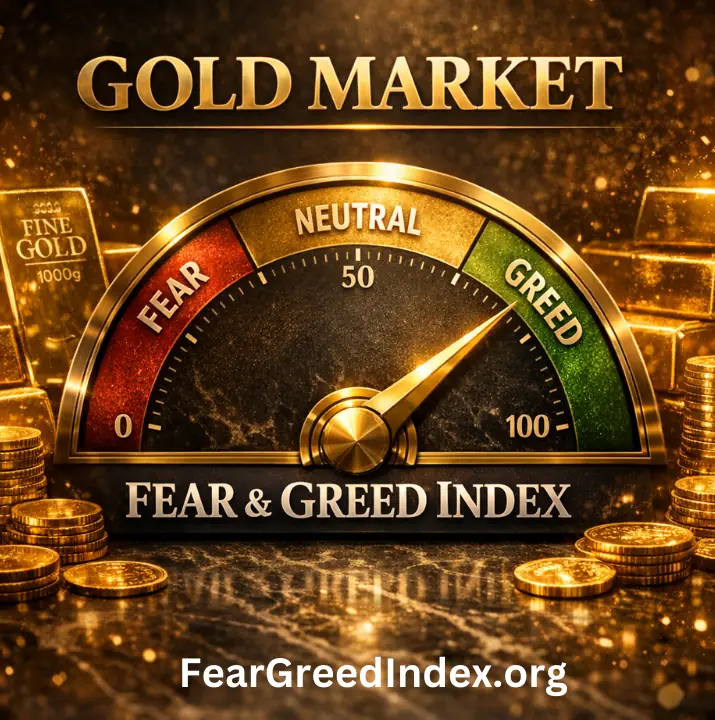
The Gold Fear & Greed Index measures sentiment toward gold and precious metals on a 0-100 scale. Use the reading together with gold prices, volatility, the US dollar and broader market conditions.
Historical Gold Sentiment Trend
The Gold Volatility Index (GVZ) and Market Sentiment
For millennia, gold has been the ultimate safe-haven asset. During periods of economic uncertainty, inflation concerns or geopolitical turmoil, investors may turn toward gold as a store of value.
Gold can behave differently from stocks and other risk assets. When stock-market sentiment becomes fearful, investors may increase their allocation to traditional safe-haven assets. You can compare this dashboard with our Stock Market Fear & Greed Index and Crypto Sentiment Index.
By analyzing gold-market volatility and sentiment, this dashboard provides context for whether precious-metals conditions are relatively fearful, neutral or optimistic.
Gold Fear & Greed Index Sentiment Zones
The Gold Fear & Greed Index uses a 0-100 scale divided into five practical sentiment zones.
How to Read Gold Market Emotions
Current Score
The current score represents the latest available Gold market sentiment reading on a 0-100 scale.
Historical Trend
Compare current Gold sentiment with previous periods using the interactive historical chart.
GVZ & Volatility
Gold volatility can provide useful context for changes in precious-metals market sentiment.
Extreme Fear (0-25)
Very low readings indicate unusually fearful conditions and heightened market anxiety.
Extreme Greed (76-100)
Very high readings indicate unusually optimistic conditions and potentially elevated complacency.
Historical Comparison
Historical observations provide context when evaluating changes in Gold sentiment over time.
How Investors Can Interpret Gold Fear & Greed
When Gold Sentiment Shows Fear (0-45)
Fear can appear during periods of unusual uncertainty, changing volatility or risk-off conditions. A low reading does not guarantee that gold prices will immediately rise.
When Gold Sentiment Shows Greed (56-100)
Greed represents stronger optimism or increased demand for the precious-metals market. Very high readings can sometimes accompany strong gold advances and increased investor attention.
Why Historical Data Matters
Looking only at today's score provides limited context. Historical observations help show whether current Gold sentiment is relatively fearful, neutral or optimistic.
Gold Trading and Interpretation Tips
- Watch the US Dollar (DXY): Gold and the US Dollar can often move in opposite directions. A weaker dollar can support gold prices, although the relationship is not guaranteed.
- Monitor real interest rates: Changes in real yields can materially influence demand for gold.
- Watch geopolitical events: Gold can attract safe-haven demand during periods of geopolitical instability.
- Study the trend: The direction and persistence of sentiment changes can be more informative than a single score.
- Do not use the index alone: Combine sentiment with price action, volatility, macroeconomic conditions and other market information.
- Avoid treating sentiment as a timing tool: Extreme readings can remain elevated or depressed for extended periods.
Gold Fear & Greed as a Contrarian Indicator
Some investors study extreme sentiment through a contrarian lens. Unusually fearful conditions can indicate that pessimism has become elevated, while unusually optimistic conditions can indicate increasing complacency.
However, extreme sentiment does not guarantee an immediate reversal. Gold can remain in strong trends for long periods because of macroeconomic, monetary or geopolitical factors.
The best approach is to use Gold sentiment as one piece of market information rather than as an automatic buy or sell signal.
Gold Fear & Greed Index Data & Methodology
What does the dashboard measure?
The dashboard represents Gold market sentiment using a normalized 0-100 Fear & Greed scale.
Gold Volatility
Gold volatility data provides important context for changes in precious-metals market sentiment.
Historical Data
Historical observations are displayed through the original Gold chart engine and its available time-period controls.
Explore Other Market Sentiment Indexes
Frequently Asked Questions
Why is Gold Greedy when Stocks are Fearful?
Gold is traditionally considered a safe-haven asset. During periods of stock-market stress, investors may move toward gold for protection. However, the relationship is not always perfectly inverse.
Does a high Gold Fear & Greed score mean inflation is coming?
Not necessarily. Higher Gold sentiment can occur because of inflation expectations, economic uncertainty, falling real yields, currency concerns or geopolitical risk.
How can I use the Gold Fear & Greed Index?
Use it as a sentiment and context indicator alongside gold price action, volatility, the US Dollar, interest rates, macroeconomic conditions and your own research.
What is the data source for this index?
The Gold dashboard uses the site's original Gold data engine and historical data endpoints. The dashboard visualizes the resulting observations through the original Gold chart and gauge system.
Is this financial advice?
No. This dashboard is provided for informational and educational purposes only and should not be used as the sole basis for an investment or trading decision.
Trading stocks, cryptocurrencies and commodities involves a high level of risk and may not be suitable for all investors. The content on FearGreedIndex.org is strictly for EDUCATIONAL AND INFORMATIONAL PURPOSES ONLY.
It should NOT be considered financial or investment advice. We do not accept liability for any loss or damage, including without limitation any loss of profit, which may arise directly or indirectly from use of or reliance on such information.